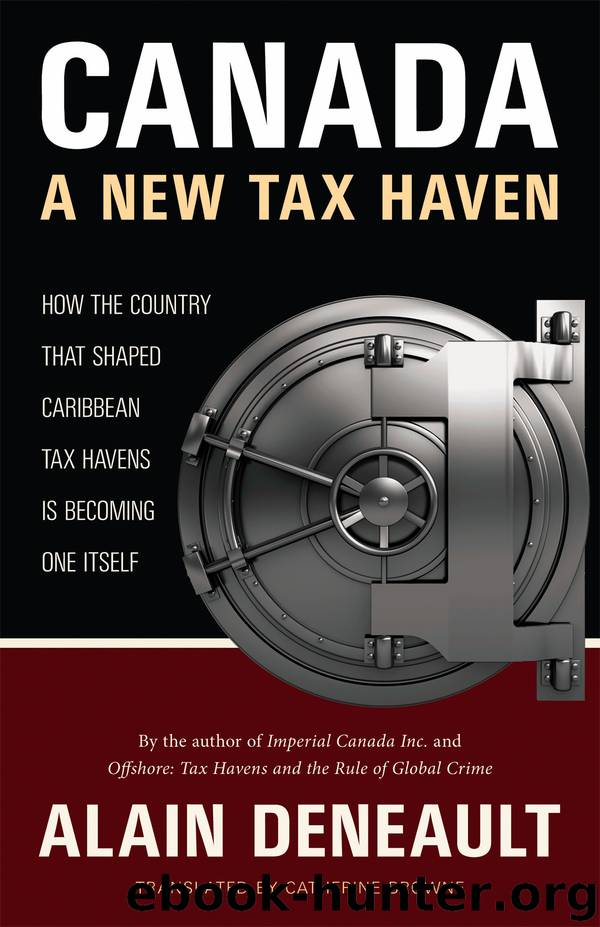
Canada by Alain Deneault
Author:Alain Deneault [Deneault, Alain]
Language: eng
Format: epub
Tags: Non-fiction, Tax haven, Business, History, tax legislation, banking, Canadian politics
ISBN: 978-0-88922-837-5
Publisher: Talonbooks
Published: 2015-12-18T05:00:00+00:00
■ 2010
PANAMA
* * *
DRUG-TRAFFICKING HUB
In which the Canadian government signs a free-trade agreement to the benefit of money launderers in Latin America
The best illustration of Canada’s accommodating attitude to tax havens is the free-trade agreement that Ottawa negotiated and signed with Panama in 2010. 1 Panama is to tax havens what a department store is to a specialized boutique. Panama is a huge laissez-faire jurisdiction willing to compromise itself in every area of activity. The country, with a population of almost four million people and a local currency pegged to the American dollar, is home to no fewer than thirty-six international banks 2 and several dozen informal financial institutions, 3 to the point where Panama City’s Obarrio financial neighbourhood can be compared with Zurich. 4 Over 80 percent of Panama’s economy derives from its offshore activities. 5 The country allows powerful industrial and financial magnates to open anonymous accounts from a distance, to create offshore companies, and to establish trusts and holding companies operating in complete anonymity, since Panama will not lift bank secrecy unless legal proceedings are already under way. As in other jurisdictions, to get Panama’s co-operation, investigators must already have the information they want to confirm; and so, in fact, Panama guarantees impunity to all those that it welcomes with open arms.
Panama has no central bank in the usual sense of the word, 6 and capital goes in and out without any form of supervision. The laws on bank secrecy are based on the Swiss precedent of 1934: 7 it is a criminal offence for a bank’s agent to disclose financial information to any foreign authority whatsoever. 8 Panamanian company law is so lenient that it is ludicrous. Directors may reside anywhere and meet anywhere they like in the world, not necessarily in Panama; they are elected by the company’s shareholders, but need not be shareholders themselves. A Panamanian company is not required to have its head office in Panama; all it needs is one resident agent, usually a lawyer. 9 There are no requirements as to the nationality of economic actors, and the initial outlay needed to start up a business is laughably small. In addition, “if the company has no activities within the Republic of Panama, it does not have to produce any kind of tax return or financial statement.” 10 For non-resident corporations, income from sources in other countries is, of course, not taxed in any way. 11 The origins of this set of laws are less than glorious. Tax lawyer Édouard Chambost notes that the Panamanian corporation law “is based on the Delaware Corporation Law of 1927, and to keep this law as stable as possible, the Republic of Panama has not adopted any of the changes that Delaware has made to this law since 1927.” 12 In Panama, a bank may be established as easily as an insurance company and, in the latter case, “the solvency ratio must be between 5 percent and 35 percent” 13 – here again there are no taxes.
Download
This site does not store any files on its server. We only index and link to content provided by other sites. Please contact the content providers to delete copyright contents if any and email us, we'll remove relevant links or contents immediately.
The Brazilian Economy since the Great Financial Crisis of 20072008 by Philip Arestis Carolina Troncoso Baltar & Daniela Magalhães Prates(310370)
International Integration of the Brazilian Economy by Elias C. Grivoyannis(111319)
The Art of Coaching by Elena Aguilar(53422)
Flexible Working by Dale Gemma;(23320)
How to Stop Living Paycheck to Paycheck by Avery Breyer(19779)
Thinking, Fast and Slow by Kahneman Daniel(12421)
The Acquirer's Multiple: How the Billionaire Contrarians of Deep Value Beat the Market by Tobias Carlisle(12379)
The Radium Girls by Kate Moore(12093)
The Art of Thinking Clearly by Rolf Dobelli(10598)
Hit Refresh by Satya Nadella(9188)
The Compound Effect by Darren Hardy(9056)
Tools of Titans by Timothy Ferriss(8493)
Atomic Habits: Tiny Changes, Remarkable Results by James Clear(8408)
Turbulence by E. J. Noyes(8113)
A Court of Wings and Ruin by Sarah J. Maas(7947)
Change Your Questions, Change Your Life by Marilee Adams(7847)
Nudge - Improving Decisions about Health, Wealth, and Happiness by Thaler Sunstein(7758)
How to Be a Bawse: A Guide to Conquering Life by Lilly Singh(7547)
Win Bigly by Scott Adams(7262)
